
Astrophysics, Particle Astrophysics, Cosmology, & Space Sciences
As part of the McDonnell Center for the Space Sciences, members of the physics department explore the origin of cosmic rays, energetic processes in galactic and extra-galactic objects, the properties of matter and spacetime near black holes, phase transitions inside neutron stars, the search for dark matter, the synthesis of heavy elements in nature, the formation of dust around stars, discovery and characterization of exoplanets, and the history of the lunar surface and of meteorites.
High Energy Astrophysics: Students work with, and sometimes design and build, instruments that are flown on spacecraft and high-altitude balloons or are used at ground-based observatories to detect cosmic-ray nuclei, gamma rays, and X-rays.
Extraterrestrial Materials: Three different types of materials are studied in the Laboratory for Space Sciences: meteorites, interplanetary dust from comets and asteroids, and lunar samples.
Gravitational Physics: Studies the observable aspects of general relativity, including gravitational waves.
Theoretical Astrophysics: Uses the fundamental laws of physics, with the help of massively parallel supercomputer simulations, to investigate observable astronomical phenomena.
Theoretical Faculty
Mark Alford
Properties of ultra-dense matter in neutron stars
Alex Chen
Plasma astrophysics & neutron star magnetospheres
Bhupal Dev
Beyond the Standard Model of particle physics
Ramanath Cowsik
Nature of dark matter
Tansu Daylan
Exoplanets, dark matter, and astrostatistics
Francesc Ferrer
Cosmology beyond the standard model
Jonathan I. Katz
Fast radio bursts & climate change
Yajie Yuan
High energy astrophysics & black holes
Experimental Faculty
Sachiko Amari
Presolar dust grains in meteorites
James H Buckley
High energy gamma ray astronomy
Ramanath Cowsik
Torsion balance studies of Einstein’s equivalence principle
Manel Errando
High-energy astrophysics, black holes, and active galactic nuclei
Jeffrey Gillis
Meteorites, spectra, space weathering, moon, Mercury
Henric Krawczynski
Space-borne X-ray & gamma ray astronomy
Alex Meshik
Solar system origin & evolution
Michael Nowak
High energy astrophysics, black holes, and neutron stars
Olga Pravdivtseva
Evolution and chronology of the early solar system
Karthik Ramanathan
Direct detection of dark matter
Brian Rauch
Cosmic ray composition & astroparticle observations
see also:
- ANITA (Antarctic Impulsive Transient Antenna)
- TIGERISS (Trans-Iron Galactic Element Recorder for the International Space Stat…
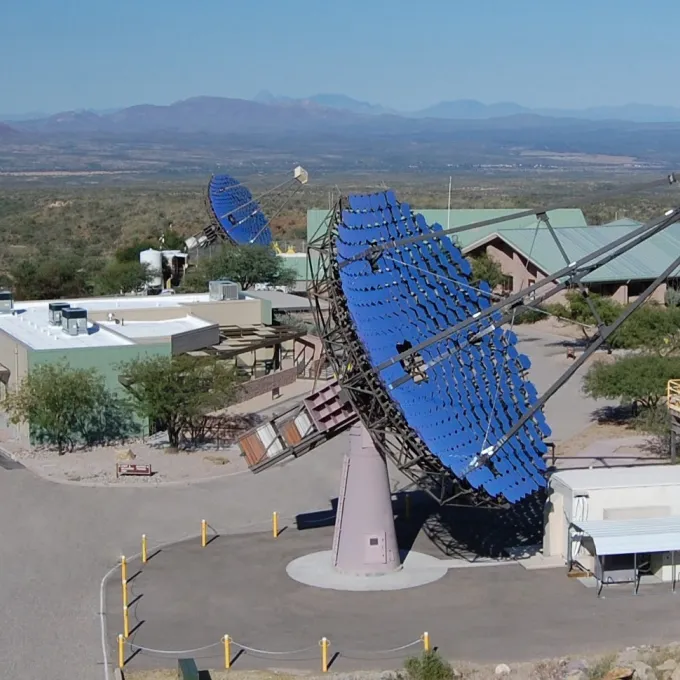
- VERITAS (Very Energetic Radiation Imaging Telescope Array System)
- CTA (Cherenkov Telescope Array)
- The LZ dark matter experiment
- ADMX (Axion Dark Matter eXperiment)
- CALET (CALorimetric Electron Telescope
- CMB-S4