2025 Robert M. Walker Distinguished Lecture Series

Planetary scientist Lindy Elkins-Tanton is the Principal Investigator of NASA's Psyche mission and currently serves as the Director of the University of California, Berkeley Space Sciences Laboratory. Her extensive background includes prominent roles at Arizona State University, the Carnegie Institution for Science, and MIT. With a resume that boasts vice-presidential duties, professorships, and notable directorships, Elkins-Tanton has left an indelible mark on the field of space exploration.
Born and raised in Ithaca, New York, Elkins-Tanton pursued her academic journey at MIT, where she earned her BS, MS, and PhD. Her research focuses on the formation and evolution of rocky planets, as well as volcanic activity and extinctions on Earth. Her contributions to science are recognized through prestigious awards such as the Explorers Club Lowell Thomas Prize and the NAS Arthur L. Day Prize and Lectureship. She has also been elected to the National Academy of Sciences and the American Academy of Arts & Sciences. Additionally, the asteroid (8252) Elkins-Tanton and the mineral elkinstantonite have been named in her honor.

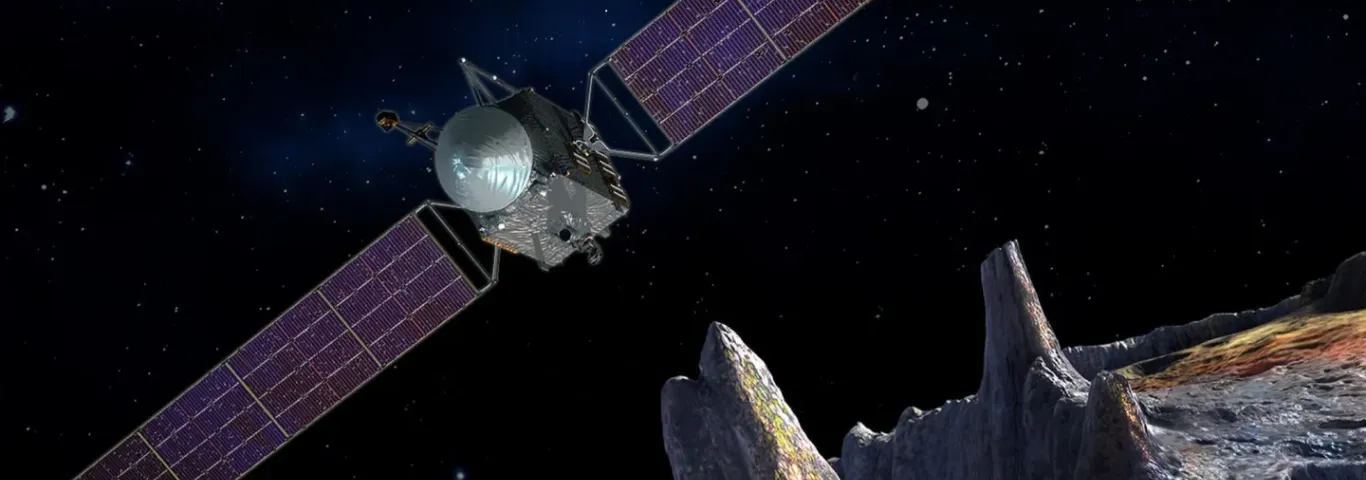
The Psyche mission, launched on October 13, 2023, promises to be humanity's first exploration of a metallic asteroid. The mission targets one of the most fascinating objects in the main asteroid belt, asteroid (16) Psyche, a potentially metal-rich remnant from the early solar system. Measuring about 130 miles (210 kilometers) in diameter and located about three times farther away from the Sun than Earth, (16) Psyche is hypothesized to be the exposed core of a planetesimal or protoplanet. Planetesimals are small, early planetary building blocks formed in the primordial solar system. These objects then merged through collisions, forming larger planetary bodies (“protoplanets”), or shattering if the collisions were violent enough.
This mission will help scientists understand how planets and other celestial bodies separated into their layers, including metallic cores, rocky mantles, and crusts, early in their formation. The spacecraft will orbit Psyche for twenty months, analyzing its topography, surface features, gravity, magnetism, and other characteristics. The mission timeline includes a Mars flyby in spring 2026, with arrival at Psyche in 2029.

Elkins-Tanton first proposed the Psyche mission to NASA’s Discovery program in 2014, emphasizing the scientific uniqueness of its target. In 2017, after two rounds of competition, NASA approved the mission, and SpaceX was contracted to launch it. Elkins-Tanton is the second woman to compete for and win a NASA mission to a major Solar System body, underscoring her trailblazing role in space exploration.
Discovered in 1852, (16) Psyche is classified as an M-type asteroid, which denotes asteroids that are composed primarily of metallic iron and nickel. Thought to be remnants of the metallic cores of protoplanets shattered by early collisions, Psyche is the largest and most massive M-type asteroid in the asteroid belt, containing about one percent of the belt's total mass. While it was initially believed to be an exposed core of a protoplanet, recent studies have proposed alternative (though still metal-rich) compositions, heightening the mission's intrigue.
Elkins-Tanton's work extends beyond the Psyche mission. She has led field expeditions in Siberia, contributing to our understanding of planetary evolution and the impact of volcanic activities on Earth's history. She is also a co-founder of Beagle Learning, a company that promotes collaborative problem-solving and critical thinking, and has written a memoir, “A Portrait of the Scientist as a Young Woman.”
In recognition of her outstanding work, Elkins-Tanton was selected to present the 2025 Robert M. Walker Distinguished Lectures. These lectures will provide insights into the Psyche mission's objectives and preparations, including the scientific instruments and data analysis. The lectures include a scientific colloquium on November 5 titled “The NASA Psyche Mission: Preparing for the Science of an Unknown Object," followed by a public lecture on November 6 titled “The NASA Psyche Mission: First Visit to an Unknown World."
Elkins-Tanton's research has shed light on complex planetary processes, such as the evolution of planetesimals and the influence of Siberian flood basalts on climate change. Her interdisciplinary approach and dedication to student-centered learning continue to inspire future generations of scientists.
William McKinnon, Director of the McDonnell Center for the Space Sciences, remarked, "Lindy's career arc is unusual and all the more remarkable for it. She has introduced several major ideas into the planetary field, and led the charge to explore an entirely new class of solar system bodies. For all MCSS members, we are in for a memorable visit."
As she aptly states, "We learn about inner space by visiting outer space." Her leadership in the Psyche mission reflects this philosophy, representing a significant advancement in humanity's quest to understand the origins and evolution of our solar system.