
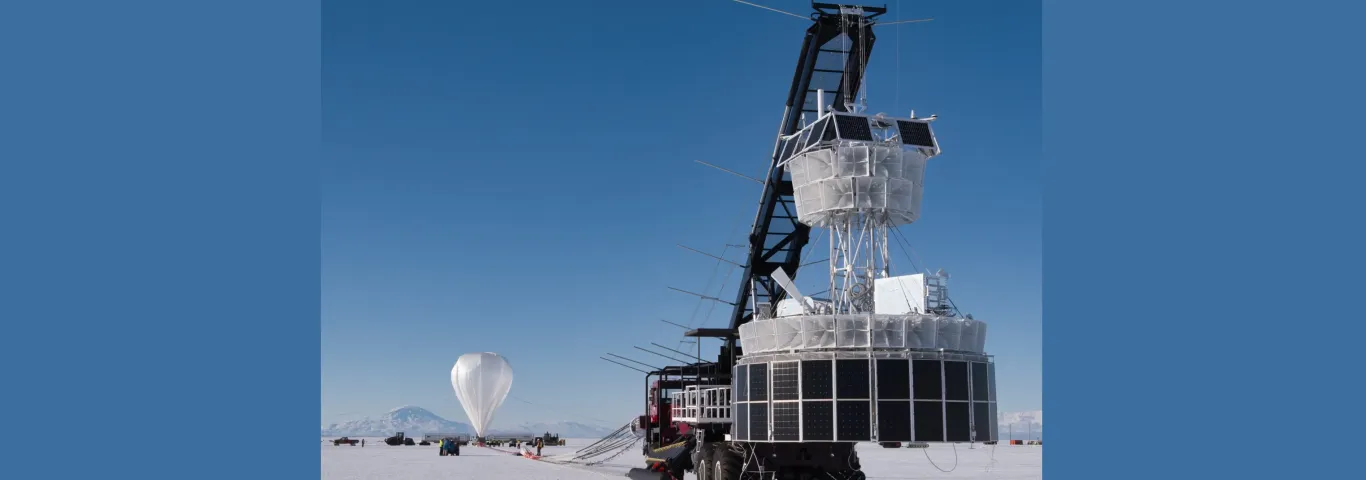
This long-duration balloon experiment, led by the University of Chicago and funded by NASA, reached a float altitude of 120,000 feet and operated for over three weeks, concluding its mission on January 12, 2026.

Washington University in St. Louis played a central role in both the development and recovery phases of the mission. Key contributors include Brian Rauch, research associate professor of physics; Lindsey Lisalda, postdoctoral research associate; and Richard Bose, senior research engineer, all members of the McDonnell Center for the Space Sciences. Lisalda and Bose traveled to Antarctica to support payload integration, focusing on the power system, which was developed at WashU and consists of solar panels, batteries, relays, and voltage converters. Most of the gondola components were fabricated in the university’s Physics machine shop. Lisalda is currently aiding recovery efforts as part of the recovery team. She has been in Antarctica since November 18 and, weather permitting, is expected to depart on February 14.
The PUEO team has confirmed that the mission gathered a substantial volume of scientific data, some of which was transmitted through telemetry during flight. In total, the experiment collected more than 50 terabytes of data. The full payload, including the equipment and dataset, was recovered from the ice by Arctic Trucks. The main instrument, designed for reuse in future missions, is already in Christchurch, New Zealand, and will soon be flown back to the United States. Lisalda has data drives in hand and will personally transport them home, a critical step in safeguarding the mission’s scientific return.
Post-mission logistics were complex. Transporting the recovered equipment, including the structure, antennas, and battery boxes, required careful coordination amid weather and cargo constraints. All equipment has been returned from the South Pole, approximately 800 miles away, to McMurdo Station. Four sea containers are designated for PUEO equipment, and all four will ship north this year.
PUEO is a next-generation balloon-borne instrument designed to detect ultra-high-energy neutrinos striking the Antarctic ice. It builds on the legacy of the Antarctic Impulsive Transient Antenna (ANITA) experiment, which was flown four times from Antarctica and also supported by WashU. While ANITA established upper limits on the flux of the highest-energy neutrinos, it did not observe neutrinos above background levels. With significantly enhanced sensitivity, PUEO is the most powerful instrument ever constructed for searching for the highest-energy neutrinos.

Ultra-high-energy neutrinos originate from extreme cosmic events such as black hole formation and neutron star mergers. Because they travel through space largely unaffected by external forces, these particles carry unique information about the most energetic processes in the universe. Detecting and studying them allows scientists to probe astrophysical phenomena that are otherwise inaccessible.
The PUEO experiment uses Antarctic ice as a natural detector, searching for brief radio signals generated by those impacts. As the first balloon mission under NASA’s Astrophysics Pioneers program, PUEO exemplifies a cost-effective approach to conducting high-impact astrophysics research.

PUEO’s advanced detection capabilities may enable the first significant observations of these elusive particles or establish new upper limits on their flux. As analysis of the newly recovered data begins, the results are expected to deepen scientists’ understanding of high-energy cosmic phenomena and help shape future neutrino research efforts.
The successful completion of PUEO’s inaugural flight marks a major milestone in the study of ultra-high-energy neutrinos, underscoring the collaborative expertise and scientific leadership that WashU brings to large-scale, international research efforts.


