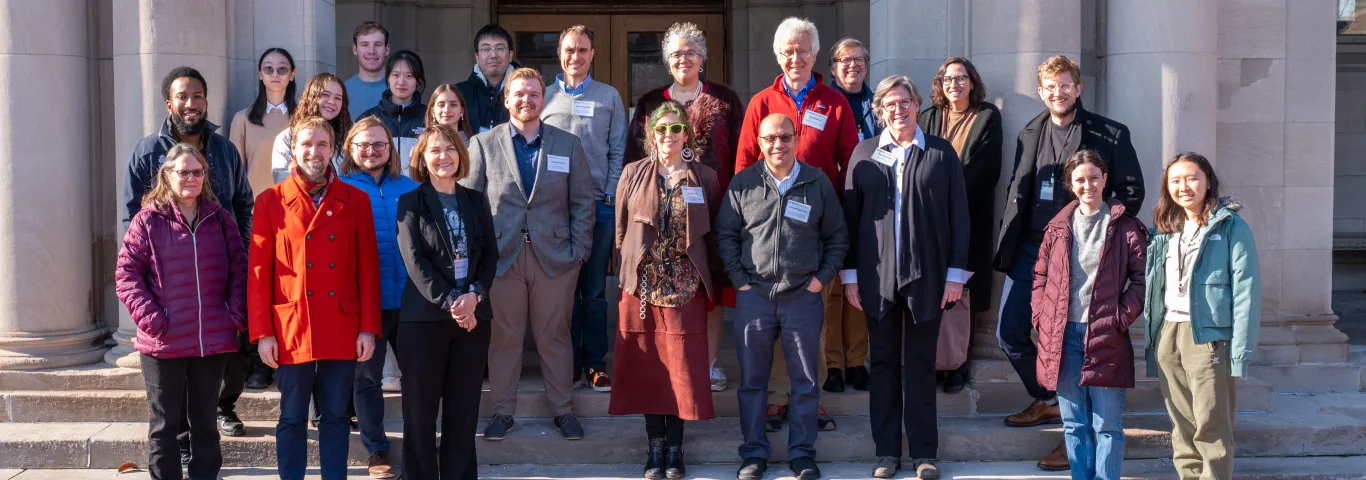
Hosted at Washington University in St. Louis, the symposium brought together ten internationally recognized artists, neuroscientists, and AI researchers for an intensive exchange of ideas. Sponsored by the cluster “Toward a Synergy Between Artificial Intelligence and Neuroscience” within the Incubator for Transdisciplinary Futures in Arts & Sciences, the event set out with an ambitious goal: to encourage genuine fusion—rather than superficial overlap—between artistic practice, scientific theory, and computational creativity mediated by AI.
From the outset, disciplinary boundaries dissolved. “Mosaic, neuroscience and AI: it's very hard to find these three words in a sentence. Yet, this workshop succeeded in bringing together mosaic artists, neuroscientists, and AI researchers in one room,” reflected AI art pioneer Ahmed Elgammal. He captured the spirit of the event succinctly: “One of the oldest art mediums meets one of the newest in an amazing interdisciplinary workshop discussion."
From Embodied Practice to Algorithmic Vision
Several presentations emphasized mosaic as a profoundly embodied, material practice — a counterpoint to the abstraction and speed of digital culture. Mosaic artists and educators explored how cutting, selecting, and placing tesserae fosters material consciousness, sensory engagement, and resistance to commodified creativity. Mosaic, they argued, is not merely an image but a slow accumulation of gestures, constraints, and human imperfection—qualities that resist automation and standardization.
At the same time, computational scientists challenged assumptions embedded in AI systems themselves. Talks on biased visual learning, human-centered computational aesthetics, and the limits of optimization-based vision highlighted how machine perception diverges from human experience. Rather than learning from billions of internet images, humans acquire visual understanding through situated, biased, and deeply personal experience—a theme that resonated strongly with mosaicists accustomed to working within physical and material constraints.
Aesthetics in the Brain: Value, Memory, and Meaning
Neuroscientific contributions added a crucial layer, grounding artistic intuition in empirical frameworks. Researchers presented work on how subjective aesthetic value emerges in the brain, showing how low-level visual features and high-level abstractions are integrated into personal preference. Others demonstrated that memorability is not accidental: artworks, symbols, and even visual designs can be intentionally crafted to be remembered—or forgotten—based on identifiable perceptual and semantic features.
Equally compelling were perspectives emphasizing meaning-making as central to aesthetic pleasure. Drawing on computational modeling, behavioral experiments, and neuroimaging, speakers argued that aesthetic enjoyment arises not just from perception, but from understanding—what aesthetics researcher Edward Vessel described as “pleasure from understanding." This interactionist view aligned seamlessly with mosaic practice, where meaning unfolds gradually through process, material engagement, and personal interpretation.
Where Art and Science Truly Meet
For many participants, the most striking outcome was the realization of shared questions across fields. “At the event, there was no boundary between art and science. I discovered we cared about the same questions and shared curiosity,” noted neuroscientist Kyo Iigaya. Researcher Brady Roberts echoed this sentiment: “Hearing from the mosaicists at the symposium really opened my eyes to the impact that our AI research has on the everyday application of aesthetics and art in society."
The symposium was deliberately designed to foster these encounters. “At the speaker’s welcome dinner, I seated every expert in their field next to an expert in one of the other fields,” said organizer Ralf Wessel. “The chatting across disciplines started right there over ramen noodles and never stopped throughout the symposium."
Building Momentum for Transdisciplinary Futures
Participants agreed that mosAIcs & brAIns was not an endpoint, but a beginning. The conversations laid groundwork for future collaborations exploring how embodied art practices can inform AI, how neuroscience can illuminate creativity, and how computational tools might augment—rather than replace—human artistry. “Communication across mosaic art, aesthetics and AI was a great success of the symposium,” Wessel added. “Now, we will build on this momentum with follow-up events to maintain sustained and impactful communication."
As neuroscience graduate student Robert Wong summarized, “We often treat art and technology as separate disciplines, yet they are both vital to the human experience. mosAIcs & brAIns did a brilliant job of bridging that gap."
In an age of accelerating automation, mosAIcs & brAIns offered something rare: a space where fragments—of stone, code, data, and ideas—were carefully assembled into a coherent, human-centered vision of creativity.