Last month, Washington University’s Department of Physics welcomed leading researchers in the hunt for dark matter during the Axion Dark Matter eXperiment (ADMX) collaboration meeting.

Organized by Professors Jim Buckley and Kater Murch, the event brought together scientists working at the frontiers of astrophysics, quantum information science, and condensed matter physics.
The meeting was supported by the Center for Quantum Leaps (CQL) and the Dean’s Office, and included a special public lecture by theoretical physicist Dr. Pierre Sikivie, known for the experimental method called the “Axion Haloscope.” Sikivie’s work, originally conceived during his tenure at WashU, laid the foundation for the ADMX experiment - the world-leading search for axion dark matter.
The axion is a hypothetical, extremely weakly interacting particle proposed to solve a problem in quantum chromodynamics (QCD), the theory of the strong nuclear force. Because of its properties, the axion is considered one of the most promising candidates for dark matter, the mysterious form of matter that makes up most of the mass in the universe.
Sikivie theorized that axions could be converted into a very weak but detectible radio frequency signal when passed through a powerful magnetic field – a prediction based on the Primakoff Effect. The experimental realization of this idea requires detectors sensitive enough to detect signals as faint as one billionth of one trillionth of a watt. To achieve this, researchers employ superconducting electronics that operate at temperatures just above absolute zero, pushing the limits of quantum sensitivity.
At the heart of these efforts are the world-class, quantum-limited readout electronics developed by WashU physicists.
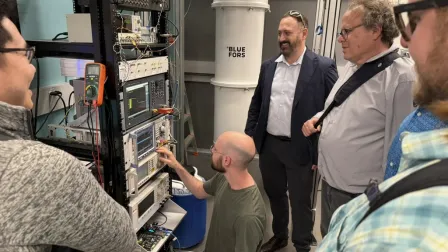
During the meeting, graduate student Jonah Hoffman presented ADMX collaborators with performance data from the Josephson Parametric Amplifier system and related electronics developed and tested at WashU. This quantum-limited system, offering best in the world performance in tuning range, bandwidth, gain, and noise, was designed by graduate students Chandrashekar Gaikwad (in collaboration with Buckley and Murch), fabricated by Kaiwen Zheng in the Institute of Materials Science & Engineering (IMSE), and tested in Buckley’s dilution refrigerator lab in Compton Hall – made possible through the support from the McDonnell Center for the Space Sciences and the US Department of Energy.
In an informal lab tour and demo, Hoffman showed the results to key figures in the ADMX collaboration, including Gianpaolo Carosi (LLNL), Andrew Sonnenschein (Fermilab), Thomas Brain (PNNL), and postdoc Nick Du (LLNL). Their visit highlighted the unique role Washington University plays in advancing the experimental technologies that make the search for axions possible.
The interdisciplinary collaboration among astrophysicists like Buckley, quantum scientists like Murch, and condensed matter experimentalists like Erik Henriksen was one of the original motivations behind founding the Center for Quantum Leaps. The ADMX meeting served not only as a technical exchange among collaborators but also as a celebration of WashU’s lasting contributions to one of the most profound questions in modern physics: What is the universe made of?