Fall 2009 Saturday Morning Seminar Series
by
Dr. Michael Friedlander
Starting in October, the Department of Physics and University College will be presenting another in its series of lectures for the general public. All lectures will be presented at 10 a.m., in Crow Hall, Room 201. Crow Hall is near the east end of the campus, directly to the north of Brookings Hall. Look for the shiny observatory dome on the roof of the building.
For information, please contact the Department of Physics
at 935-6276. The lecturers will be members of the faculty in the Department
of Physics.
These lectures are free and open to the public; no registration
is required. |
| 2009 - International Year of Astronomy
The International Astronomical Union (IAU) and UNESCO have designated 2009 as the International Year of Astronomy. This Year is being celebrated in many countries and in many different ways. There have been celebrations at the University of Padua where Galileo Galilei made his discoveries in 1609. In our Saturday Science series in the spring, we saluted Galileo Galilei. For our fall lecture series, we have chosen to highlight four topics that are currently of great astrophysical interest. Lectures will be presented by faculty in the WU Department of Physics, talking about subjects in which they themselves are engaged in research.
October 17: Professor
Ernst Zinner
Production of the elements: evidence from fossils older than the Solar System
Nuclear processes in stars are a necessary condition for life on Earth. They produce the energy that makes our Sun shine, but they also produce the elements, such as carbon and oxygen, that make up ourselves and all living organisms. While in the past, evidence for the production of the elements came from astronomical observations, in the last two decades a new source of information on stellar nucleosynthesis has become available in the form of tiny pieces of bona fide stardust. These grains, condensates from stellar atmospheres, are found in primitive meteorites, from which they can be extracted and studied in detail in the laboratory. By measuring their isotopic compositions, we can obtain information about their stellar sources and the nuclear processes that produced the elements.
October 24: Professor
Clifford Will
Roll Over Galileo: The New Astronomy of Gravitational Waves?
Since the time of Galileo's refinement of the telescope 400 years ago this year, almost all astronomical discoveries have been made using light, whether in the visible part of the spectrum, in the long wavelength bands of radio waves or microwaves, or in the ultra-short wavelength bands of X-rays and gamma-rays. Some important discoveries have also been made using cosmic rays (atomic nuclei, neutrinos) from outer space and using larger objects like meteorites and dust grains. But some time during the next 10 years, a completely new kind of astronomy will begin, using waves of gravity, a phenomenon predicted by Einstein's general theory of relativity. We will describe how a worldwide network of gravitational-wave observatories is now poised to detect these waves, which are emitted during some of the most violent and catastrophic events the universe has ever seen, such as the stellar implosion that takes place during a supernova, or the merger of two supermassive black holes in the center of a galaxy. We will also describe plans being developed for a space-based observatory, called LISA. Because of the way gravitational waves work, we will show how gravitational-wave astronomy will be more like "listening" to the universe than "seeing" it.
October 31: Professor
Henric Krawczynski
Radio and Gamma-Ray Observations of Supermassive Black Holes
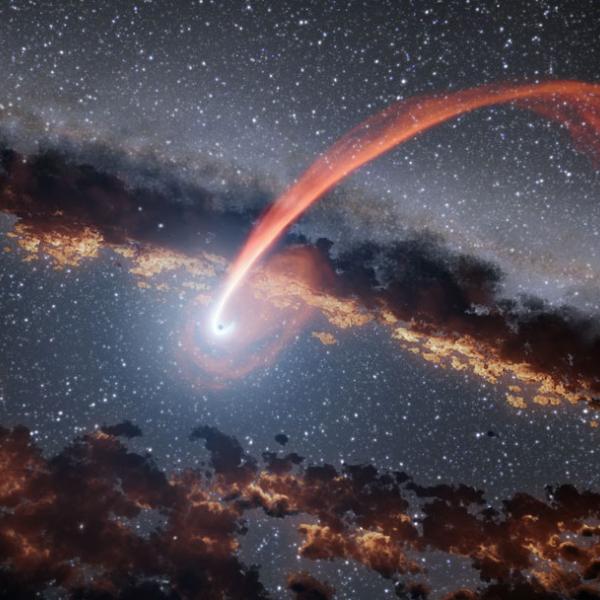
When Nature squeezes a sufficient amount of matter into a small volume, a black hole forms - an object which is so massive and so compact that nothing can escape its gravitational pull - not even light. In the last several decades, scientists have accumulated a large body of circumstantial evidence that cosmic black holes do exist. Indeed, there is strong evidence that every massive galaxy in our Universe harbors a "supermassive black hole" - a black hole with a mass exceeding one million times the mass of the sun. In this talk, we will start with a brief overview of the concept of a black hole, describing some of the observational evidence for the existence of astrophysical black holes, and presenting recent results from our own research: radio and gamma-ray observations of the center of the radio galaxy M 87. The observations indicate that violent processes in the immediate surrounding of a black hole with a mass of 6 billion solar masses accelerate particles (most likely electrons) to extremely high energies. We will conclude with a discussion of the processes which might lead to the acceleration of particles close to the black hole.
November 7: Professor
Mark Alford
Cosmology and Particle Physics
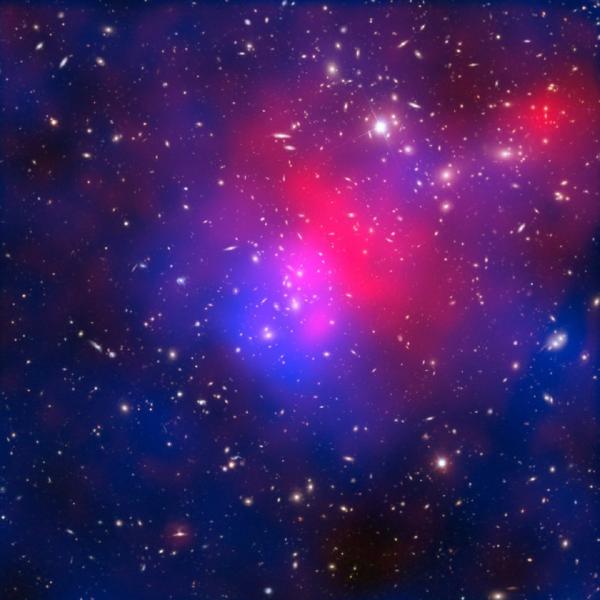
We now know that we live in an expanding universe, where mysterious "dark matter" shapes the galaxies and even more enigmatic "dark energy" is driving the expansion rate faster and faster. Meanwhile, in Switzerland the Large Hadron Collider (LHC) is about to probe the building blocks of matter at the smallest distances ever explored. How does our knowledge of the smallest particles help us to understand the structure and history of our universe? That is the topic of this lecture.
|